
In Xinduan Village, piles of plush products in various styles are stacked high as e-commerce merchants prepare for “Double 11” (Singles’ Day shopping festival).
Turning a 12-centimeter square piece of plush cloth into a “fur ball” pendant that foreigners can’t get enough of takes 66-year-old Bao Yuecui just one minute.
With the plush side facing out, she stitches three times on each edge, gathers it into a semi-circle, stuffs the center with leftover scraps, and sews the four edges together into a firm ball. The final stitch attaches a small hanging ring. This task, requiring 13 manual stitches, is done without delaying her housework. Bao Yuecui says she can make at least 300 of these a day, easily earning around 1,500 yuan a month at a leisurely pace.
Unlike Bao Yuecui, 38-year-old mother of two, Sun Minhua, uses a sewing machine. While watching her children and managing a small shoe store, she handles this processing work with ease. She makes fur leg warmers and gloves in winter, and cloth patches and small accessories in summer. “I just do it whenever I have a spare moment.” Her income is higher than Bao’s: “In good times, I make over 10,000 yuan; normally, it’s around six or seven thousand yuan.”
In Xinduan Village, Mohe Town, Xinyi City, Jiangsu Province, over 1,400 of the village’s fewer than 1,500 households are engaged in the production and sales of faux fur. Fashion items from here have not only reached the runways of developed countries in Europe and America, but the “fluffy” industry, with an annual output value exceeding 700 million yuan, has also become a genuine wealth-generating industry for the locals.
Faux Fur: The True Path to Riches
Chen Deliang, who has worked in the “faux fur” industry for over 20 years, defines himself as a “fur broker.” He manages over 100 fixed processing households like Bao Yuecui and Sun Minhua. Every morning, Chen distributes materials to them and collects the finished products in the evening at an agreed price. Once he accumulates enough volume, he ships them to Yiwu, Zhejiang, 700 kilometers away, from where they are shipped or flown abroad. “At peak times, we can ship over 30,000 pieces a day; normally, it’s about 8,000 pieces daily.”
There are over a dozen fur brokers like Chen Deliang in Xinduan Village. Chen estimates that these brokers alone sell no fewer than 90 million fur ball pendants annually.
The fur industry in Xinduan Village began in the early 1970s, mainly relying on township-run fur factories to process small toys, keychains, and accessories. Sales were good, and it became a locally famous “fur processing village,” producing “Ten-Thousand-Yuan Households” (a term for wealthy families in the past). Fur processing became an important channel for villagers to get rich. Around 2006, as the domestic breeding industry declined, Xinyi’s fur processing industry faced unprecedented challenges. Most skilled villagers went to work in Yiwu, Zhejiang. There, some villagers encountered faux fur products and brought the concept back to Xinyi. Xue Yizhen was one of them.
Xue Yizhen, formerly in the transport business and recognized as one of the “economically savvy” people in the village, spotted a business opportunity while delivering goods to Yiwu: small plush products had a huge market. He brought some back, and they sold well. “Back then, we used real fur, and the price was high—a pair of boot covers cost 180 yuan.” In 2010, faux fur products appeared on the market. Seeing the potential, Xue quit his transport business, bought five sewing machines and fabric, and taught himself to produce these small accessories. Leveraging Xinduan Village’s traditional fur processing skills, he soon “imitated” over a dozen popular plush products, achieving nearly 1 million yuan in sales that year. By 2016, Xue Yizhen had become a renowned faux fur processor in the village, with annual sales exceeding 10 million yuan.
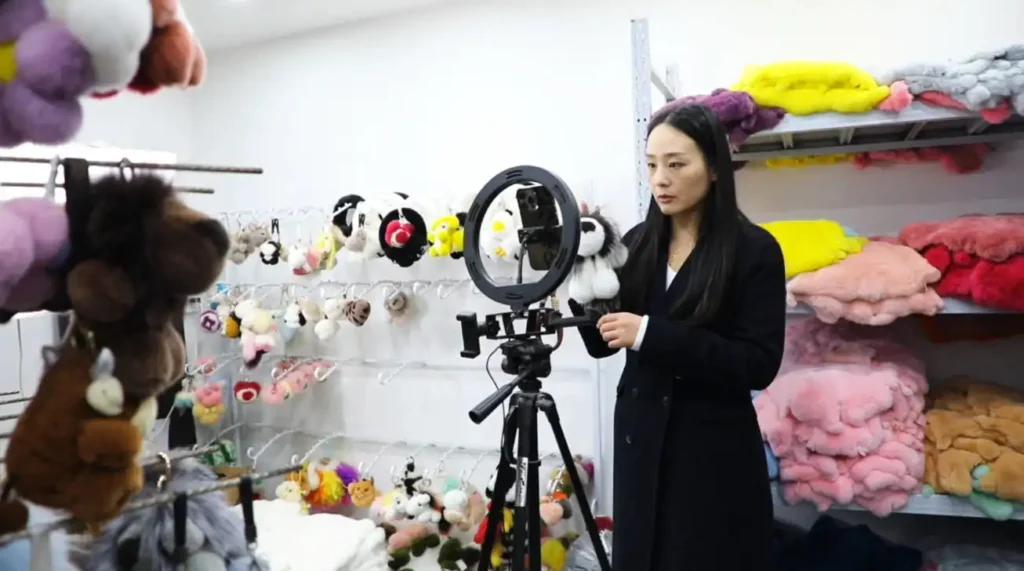
Before 2005, the per capita annual income in Xinduan Village was less than 5,000 yuan. By the end of last year, it exceeded 50,000 yuan. Small fur products have truly revitalized their economy.
Xinduan Village’s faux fur industry, which started in 2009, had sales of 20 million yuan in 2011. By 2016, seven years later, it surpassed 700 million yuan for the first time. Despite the massive scale, one cannot find a single physical store in Xinyi; the entire industry relies on e-commerce.
Small Fur “Goes Digital” for a Rebirth
Although “Double 11” is still some time away, Zhang Qing began stocking up two months in advance. Not far from the industrial park, in a building serving as both office and warehouse, piles of black, red, and yellow plush earmuffs fill the hundreds of square meters of space. “The value of the goods is no less than 500,000 yuan.”
Zhang Qing, a graduate of Xuzhou University of Technology, was named one of Xinyi City’s Top Ten Young Entrepreneurial Talents and elected as a representative to the People’s Congress due to his success in e-commerce. As he puts it, he never intended to look for a job after graduation. “Isn’t selling faux fur products online and being my own boss better than anything else?” He started an online shop in 2013 and made 8,000 yuan in the first month. Now 25, Zhang Qing has shops on multiple e-commerce platforms. regarding his annual sales, he says it’s a secret for now, “but it’s definitely more than you imagine.”
Xue Yizhen, a burly man, gave his faux fur clothing company a very feminine name: “Dai Xiu” (meaning “Show Everyday”). “It means showing off to everyone every day.” As one of the few large-scale fur processing enterprises in the area producing tens of thousands of faux fur garments annually, Xue does not sell a single product himself. Instead, he maintains long-term cooperative relationships with 15 reputable and capable e-commerce merchants. “They specify the styles, we design and produce, and they handle all the sales.” All 15 merchants are based locally in Xinyi, including Zhang Qing.
Unlike Xue Yizhen, who is purely a supplier, Xu Jing’s company, “Qian Jun Na,” engages in both production and online sales. The biggest characteristic of e-commerce sales is the rapid update of products; new styles emerge endlessly. “The advantage of this is that we can keep up with market trends in real-time and easily discover ‘explosive’ (best-selling) new products.” Last year, Xu Jing sold a “hit” plush vest. “We noticed the vest was selling wildly online, so we designed and produced it overnight. We had the product ready in 4 hours. It went online the next morning while the factory ran at full capacity. We sold nearly 20,000 pieces in a month.”
Faux fur e-commerce is not just for the young. For 50-year-old Shi Sichao, doing business online is no harder than it is for his son.
Shi Sichao opened his online store in 2010, making him one of the first in the village to embrace the internet. “Before doing e-commerce, I sold fur accessories in Yiwu, but the small items I sold were all produced in our Xinduan Village. Later, I thought, why can’t I sell them online from home?” With the help of his son, Shi Guangji, he opened a clothing store named “paulgust.” “The first time I sold clothes online, I made over 100,000 yuan in one winter. That was unimaginable before.”
Entering Xuhai Road in Xinyi via Provincial Highway 323, the first thing one sees is a sign reading “Jiangsu Province E-commerce Demonstration Village.” Lining both sides of the road are rows of faux fur processing and e-commerce shops. Currently, Xinduan Village has over 300 pure processing households and over 800 “processing + e-commerce” households. Including brokers, there are over 1,480 households engaged in the faux fur business. These production and sales activities formed spontaneously, with over 95% of the villagers involved in the trade.
According to data from Taobao and Alibaba, over 80% of faux fur product sales across the entire web come from Xinyi, Xuzhou, Jiangsu. Local statistics show that in 2016, the e-commerce output value of Xinduan Village was approximately 1.16 billion yuan, with faux fur apparel alone contributing 780 million yuan. Of the total cross-border e-commerce transaction volume of 2.072 million USD, fur accounted for 312,000 USD.
Making Small Fur into a Grand Industry for Wealth Creation
Wang Lin, who has done fur foreign trade for nearly 20 years, owns two fur clothing companies. “Shengda Fur” was the name he used initially in Yiwu, “mainly for real fur foreign trade.” In 2013, he moved his processing factory back to Xinduan Village and established a company named “Duolanna,” “mainly for faux fur clothing products.” In 2016, Wang Lin’s fur export business reached 10 million yuan.
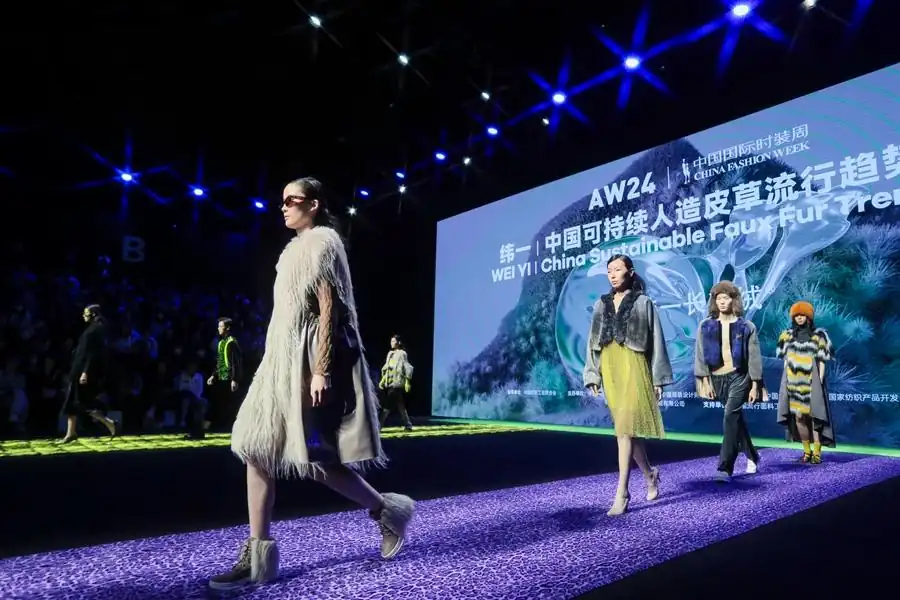
The goal of Xinyi City establishing the Fur Industrial Park was to guide the faux fur industry from loose operations to large-scale production, strengthening it to become an export product with significant market share.
Since the 18th National Congress, the Xinyi municipal government has introduced a series of policies to support the development of the faux fur industry in Xinduan Village. They established policy guidance funds to encourage individuals and companies to move away from the “front shop, back factory” family workshop model and into unified standard factories. They also provided tax incentives, planning and constructing a 53,000-square-meter park gathering over 50 enterprises involved in production, processing, and e-commerce services, driving employment for over 20,000 people.
To facilitate exports, a customs office was set up, and a clothing design talent recruitment fund was established to turn the Fur Industrial Park into a platform for “Mass Entrepreneurship and Innovation.” In 2015, Xinduan Village introduced faux fur fabric manufacturers, establishing a faux fur industrial park. Over a dozen logistics companies moved in, creating a complete industrial chain integrating raw material production, clothing design, garment manufacturing, online and offline sales, and logistics.
In 2016, the export value of faux fur from Xinduan Village reached over 20 million USD. Today, faux fur products from this small northern Jiangsu village—ranging from apparel to accessories and ornaments—not only occupy 80% of the domestic Taobao market but are also exported to the US, France, Spain, Italy, Russia, Ukraine, Japan, South Korea, and other countries and regions.
“Looking at the status of the faux fur industry nationwide, only Mohe Town has achieved centralized and large-scale production,” Song Guannan, head of the Xinyi Fur Industrial Park, told the reporter. Although Xinyi’s faux fur industry is the largest in the country after decades of development, issues such as small individual scale, insufficient innovation, weak market risk resistance, and lack of obvious international competitive advantages have gradually emerged. “This requires government guidance to form a sufficiently strong industrial advantage.”
In 2016, a large, resource-saving, environmentally friendly, and sustainable Fur E-commerce Service Industrial Park was completed and put into use in Mohe Street, where Xinduan Village is located. The park, with a construction area of over 50,000 square meters, integrates six functions: product display, e-commerce incubation, intelligent warehousing, comprehensive services, production processing, and supporting living areas. The first batch of 42 sizable faux fur clothing production and sales companies, including those of Xue Yizhen and Xu Jing, moved in. That year, e-commerce sales reached 88 million yuan. By June 2017, the Mohe fur processing industry accounted for 80% of network-wide sales in e-commerce trade, with a daily sales volume of over 10,000 orders. The annual transaction volume broke the 100 million yuan mark, an increase of nearly 30% compared to the 85 million yuan before the park’s establishment.
Currently, surrounding the Xinyi Fur Industrial Park, over a hundred direct sales companies from plush fabric manufacturers have gathered, along with hundreds of hardware sellers supplying garment production. “Put it this way: to produce a batch of faux fur clothes, you can procure all the necessary raw materials and accessories without leaving the street,” Song Guannan explained. Xinduan Village’s faux fur business has formed a relatively complete industrial chain from raw materials to processing and sales.
“The industrial park has three missions: first, to promote the clustering of the fur industry; second, to improve the effectiveness of entrepreneurship in the fur industry; and third, to effectively enhance the innovation capability of the industry, as well as establishing norms for industry behavior,” Song Guannan said. With such a strong industrial foundation in Xinyi’s faux fur sector, combined with the unprecedented opportunity of “Mass Entrepreneurship and Innovation” and the rapid development of the internet express train, “there is no reason for it not to grow into a major industry that enriches the people.”